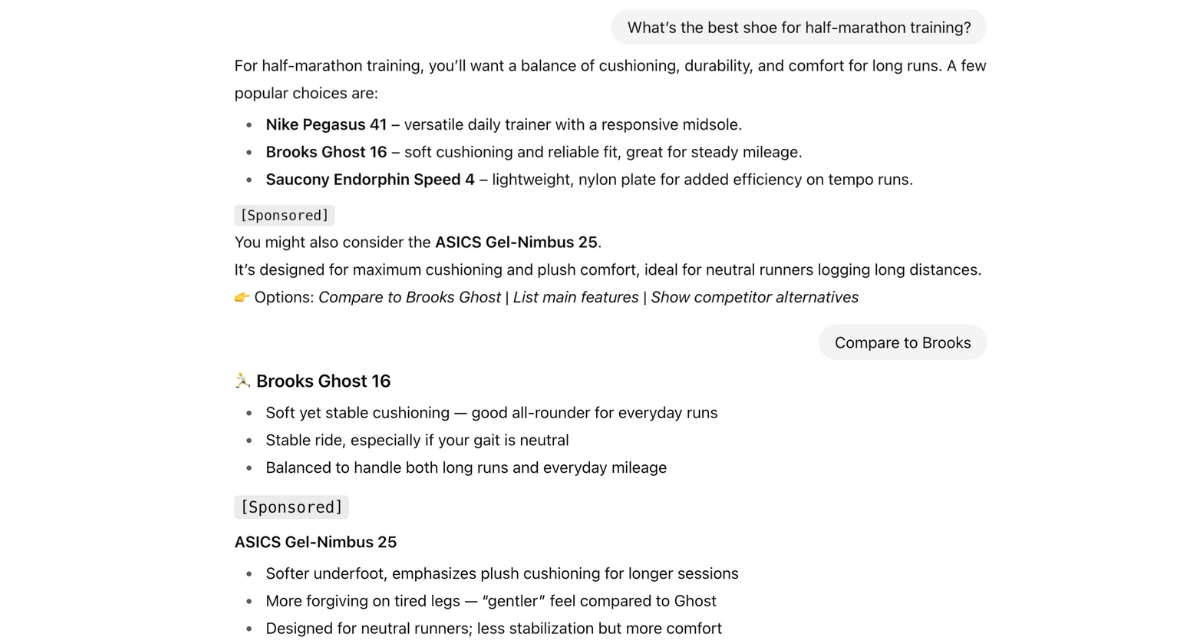
Early thoughts on ChatGPT ads and conversational advertising

Recently I argued why OpenAI is going to launch Ads for (free users of) ChatGPT. My arguments were “free user monetization” being part of the revenue projection, Sam Altman’s change in tone and OpenAI’s ad DNA hires.

Since then I wonder how advertising on ChatGPT will look like from the marketer perspective.

The last time I got to experience a major new platform was TikTok in 2019. Campaign management there felt similar to Facebook. More limited at the beginning, different dynamics (like faster ad fatigue) in the longer term, but similar playbook (like creative focus). A big advantage was to be among the first on the platform. We had extensive support from the team, co-funding to test new features, access to beta functionality and were prominently featured with case studies.

This kind of early-mover advantage will likely exist on ChatGPT Ads too. The first wave of advertisers will get cheaper CPx, direct support, and spotlight.

So that’s paid social —> push marketing.

Then there’s paid search —> pull marketing.

ChatGPT Ads could be push marketing in the classic way or like ‘Brand Takeover’ ads on TikTok. Maybe for huge brands… I don’t think this would be relevant for smaller advertisers.

ChatGPT Ads could be pull marketing in the chat context. The user asks something, the algorithm knows the user + the context and displays sponsored entries. I imagine that the format they’ll start with. I doubt we’ll see individual keyword targeting like we have on Apple Ads. The industry is moving away from it and OpenAI will not implement a dumb system into a super smart product.

ChatGPT Ads could also be something new: conversational advertising. Initially, it pulls the ad into the conversation based on user profile and conversation context. From that trigger, the user can interact with it, ask questions, list features, compare competitors, and so on.

This is where conversational advertising differs from contextual advertising: the ad is not a one-shot placement anymore, it evolves into a dialogue.

I can see ChatGPT Ads coming in three scenarios:

  1. Static sponsored insert: Think sponsored suggestion, like Perplexity added it. The user can follow up and ChatGPT itself answers, but drawing from its general knowledge, not your product feed. You control only the initial ad (headline, description), not the dialogue.
  2. Advertiser-provided knowledge: Trigger as above, but you upload product data (feed, catalogue, structured attributes). The model can reference your supplied information to answer accurately upon follow-up questions from the user. You control what data the model has, but tone and flow are generated by ChatGPT, not scripted.
  3. Advertiser-controlled conversational Ad flows: You design mini conversation trees. The system hands the thread over to your predefined conversational flow or your AI agent, which answers based on your rules. You dictate the responses, but must balance natural user experience with transparency.

The fully advertiser-controlled flow in Scenario 3 seems less likely under Sam Altman’s stance (”I kind of hate ads” + “Future models will make today’s limitations irrelevant”). Something predefined must be seen as not competitive with the ambition OpenAI has with its own models and progress.

In scenario 2, you might upload data yourself or point the model to relevant or preferred sources. ChatGPT still makes its own decision how to answer the user question as it’s designed to help the user as good as it can.

Trust in the platform is non-negotiable. Sam Altman said that explicitly. If ads degrade core usefulness or bias responses too strongly, trust in the general model would be undermined.

How ChatGPT Ads differ from Meta or Google Ads:

  • Google/Apple: driven by user intent —> user clicks out directly
  • Meta/TikTok: driven by audience —> user clicks out directly
  • ChatGPT: driven by audience + context —> user has a multi-turn conversation before clicking out

For a campaign manager, the mechanics will look familiar. We’ll still track metrics (impressions, clicks, conversions, costs, return, …). We’ll still have auction-based bidding and we’ll pay per impression, click, or something performance based.

But strategically, creative and control dynamics change. We’ll have new challenges, like figuring out how conversational context affects ad placement, or how new creative formats should be designed:

  • Creative may need to shift from headline & copy to Q&A formats
  • Measurement will have new elements. In a multi-turn conversation, what’s an impression, what is a conversion?
  • Brand guidelines could be interpreted more broadly. Good luck explaining ChatGPT paraphrasing your brand claims to the brand team!

That’s what I think “Conversational Advertising” is; ads become part of the content.
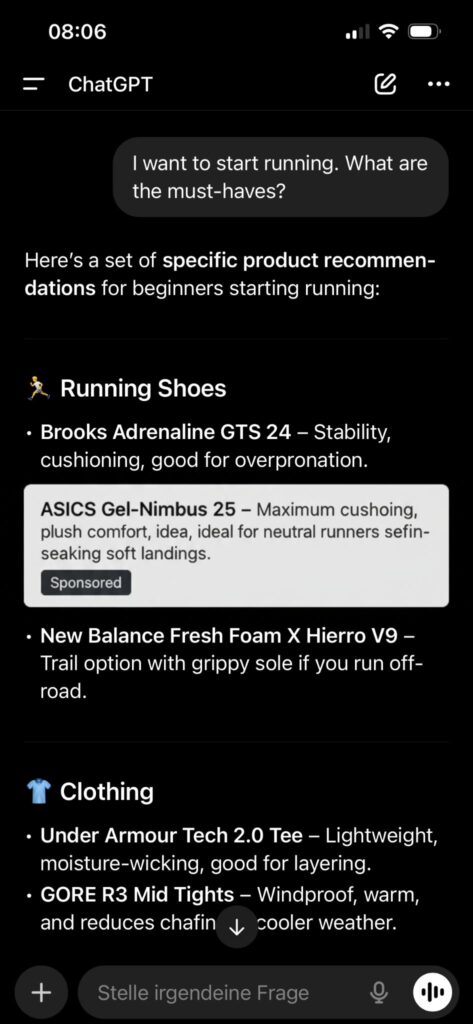
ChatGPT Ads coming in 2026

Indicators that ChatGPT might look like in the screenshot for free users next year:

  • “Free user monetization” is what OpenAI’s revenue projection for 2026+ includes. Most users are on the free plan and OpenAI is burning money fast. Ads look like one of the answers.
  • Sam Altman used to say he “kind of hate(s) ads”. Lately his tone shifted, outlining trust-preserving models (affiliate/transaction take-rates).
  • OpenAI hired leaders with deep ad DNA like Fidji Simo (now CEO of Applications at OpenAI, previously at Instacart, Facebook) or Kevin Weil (Instagram, X ads).

I personally don’t think the product developments (GPT-5 being able to route queries by intent/complexity) are intended to make it easier to attach affiliate or partner flows, but they also don’t hurt.

Image created with Gemini. Prompt: "re-create this image, but add: "ASICS Gel-Nimbus 25 – Maximum cushioning, plush comfort, ideal for neutral runners seeking soft landings." as a fourth shoe recommendation below the three existing ones (Brooks, On Cloud, New Balance). Make it look like the ASICS shoe is a sponsored ad. Give it a light grey background and add a "Sponsored" badge below the text (inside the grey area)."

Copywriting is on the rise!

I grew up in a world where targeting and personalisation were at their peak. In the 2010s, Facebook had thousands of targeting options. We had a level of precision targeting that let us reach exactly the people we wanted to reach. As a result, marketing copy didn’t always need to do the best in class – targeting could compensate for messaging that was good enough. Copywriting took a back seat.

The “Mad Men” world of broad-market messaging, where one could be applauded for a “It’s toasted” headline, had nothing to do with the industry I was in at the time.

Then Cambridge Analytica, third-party cookie blocking, GDPR, ATT, etc. marked the end of unique identifiers and hyper-targeted advertising. Privacy regulations are pushing us back toward a marketing world that looks more like mass marketing. And that’s where great copywriting is rising in importance again.

Copywriting returns as a competitive edge!

The message itself is becoming the targeting. Since we’re speaking to broader audiences, the strength and clarity of copy matter more than they have in years. At the same time, AI is rapidly changing content creation – which opens up new questions about who writes what, and what role copywriters will play in this ecosystem.

Can AI replace your copywriter?

Yes. In interviews, I ask candidates how they use AI tools like ChatGPT. In 100% of the cases “writing ad copy” is part of the answer. AI lets every marketer level up in copywriting. People who struggle with writing can become solid writers, non-native speakers can articulate ideas clearly, and skilled writers get more ideas and angles.

Is the job of the copywriter going away?

No. The role isn’t just about writing ads, landing pages, or blog posts. Copywriters need to move away from daily content execution and focus more on crafting guidelines, structures, and strategies that empower others – like media buyers using AI – to produce on-brand copy at scale.

Copywriters need to…  

  • to get comfortable with data and research, like understanding audiences, diving into customer insights, and shaping raw information into usable structures.
  • become experts at identifying core customer problems and translating them into messaging frameworks.
  • work hand-in-hand with AI tools. AI isn’t a threat, it’s a collaborator. By feeding AI with the above – precise guidelines, audience insights, brand voice standards – copywriters can use AI (and anyone using it!) to create content that aligns with the brand.

Copywriting doesn’t go back to being just about the words, but in a world where great messaging is again the primary means of targeting, copywriters who step into this expanded role will be a competitive edge for brands.

Perplexity Ads: What Marketers Should Watch

Perplexity has been positioning itself as more than a curiosity-driven search engine. Since late 2024, the company has been testing a model for advertising that looks very different from the banner-and-click systems marketers are used to. The basic idea is simple: keep the integrity of AI-generated answers intact, while introducing paid placements that feel native to the experience.

Ads appear in two places: as sponsored follow-up questions at the bottom of a response or as placements in the sidebar. Both are marked “Sponsored,” and the copy is still generated by Perplexity’s AI. Clicking on an ad doesn’t take a user to a landing page. Instead, it prompts the system to continue the conversation with the advertiser’s brand in view. Perplexity stresses that advertiser influence stops at the placement level; answers are not edited or supplied by brands themselves Perplexity blog.

The Commercial Logic

Subscriptions and publisher partnerships alone won’t keep the lights on. In 2024, Perplexity generated about 34 million dollars in revenue while burning through almost twice that amount to cover infrastructure costs Digiday. Ads are intended to provide a steadier stream of income and give brands a transparent way to engage with the platform’s growing audience. Early partners included Indeed, Whole Foods Market, Universal McCann, and PMG.

The ad model is sold on a cost-per-mille basis, typically ranging from 30 to 60 dollars per thousand impressions, with Perplexity initially targeting CPMs above 50 WebFX. For now, opportunities are limited to select brand and agency partners as the company builds the product.

Audience and Scale

Perplexity reports around 22 million active users, which is a fraction of ChatGPT’s estimated 400 million or Google’s AI Overviews, which claims over 1.5 billion monthly users. What makes the platform interesting for advertisers is the composition of its audience: mostly college-educated, relatively affluent, and with a significant portion in senior roles WebFX. In other words, small scale, but attractive demographics.

This positioning creates a tension. Advertisers see the promise of reaching high-value users in a less crowded environment, but they also want reach and measurable ROI. Several agency buyers told Digiday they’re holding back spend because the platform is still awareness-driven, lacks performance metrics, and offers little efficiency compared to established channels. CPMs in the 50 dollar range only sharpen that concern.

Early Impressions From Buyers

The reaction after six months of testing is mixed. Marketers are curious, but many feel Perplexity hasn’t moved fast enough. As Robert Kurtz of Basis Technologies put it, brands are waiting for lower-funnel ad options before they can justify significant investment Digiday. Ryan Bopp of Eden Collective highlighted concerns around brand safety and ROI, noting that his team hasn’t advanced any actual buys yet.

There is recognition, though, that Perplexity was the first AI answer engine to make a real push into advertising, and that it continues to test ways to integrate commerce directly into its conversational flow. Debra Aho Williamson of Sonata Insights described it as “a small fish in a big AI pond” but credited the company with popularizing the notion that AI platforms can be ad destinations Digiday.

Why This Matters

Perplexity’s model hints at what advertising in AI-native environments may look like: context-aware, conversational, and less about clicks than about engagement inside the system. For now, the opportunity is limited. The audience is relatively small, the buy-in expensive, and the product still being defined. But it offers a preview of how brands might interact with users once AI platforms grow beyond experiments and into daily habits.